

By Blake Stretton, Gittoes Real Estate
Last updated: September 2026, using data through the end of August 2026.
This is our Central Coast property market update for August 2026: where the market sits and what we are seeing in our own campaigns.
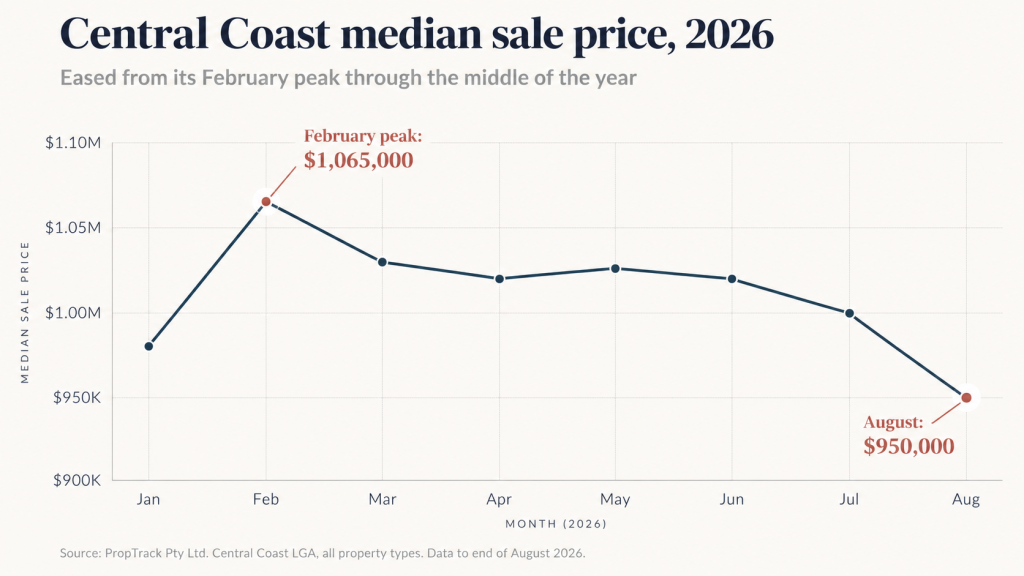
Quick answer: The Central Coast market has cooled from its February peak. The median sale price is $950,000; there are more homes for sale than a year ago, and properties are taking longer to sell. Buyers haven’t disappeared, but they have more choice, more time and less willingness to overpay. Well-presented, correctly priced homes are still selling well.
The August 2026 numbers at a glance
The market data for the Central Coast to the end of August paints a consistent picture of how conditions have changed.
- Prices have eased from their peak. The median sale price is $950,000, down from $1,065,000 in February, a fall of about 11%. It remains slightly above where it sat a year ago ($940,000 in August 2025), and well above the $724,000 median of January 2021.
- There is more for buyers to choose from. There are 2,467 homes actively on the market, up from 2,083 a year ago, an increase of about 18%. More stock means more competition between sellers.
- Homes are taking longer to sell. The median time on market is 52 days, up from 32 days in March and 38 days in August last year.
- The gap between listed and sold prices has shifted. In August, the measure was around 1% below the listed price, compared with around 7% above in February.
- Rents are holding up. The median weekly rent is $670, up from $640 a year ago, an increase of about 5%.
Together, these point to a market rebalancing after a strong run, with conditions increasingly favouring buyers.
One thing to keep in mind about the median: it is a whole-of-region figure covering all property types. It is a useful gauge of the overall market, but it is not the value of any individual home, and a softer median does not mean every property or pocket is worth less.
What we are seeing in our own campaigns
This is where the numbers meet reality across the Central Coast.
Buyers are more selective, and more willing to negotiate. With more stock available, buyers no longer feel pressure to secure something immediately. They are very conscious of recent comparable sales and of what else is on the market, and if a property is priced ahead of where the market sits, they will not stretch simply because they like it. They will negotiate, in some cases fairly aggressively, or wait. They are also taking their time, comparing several properties and often coming back after looking elsewhere, which is why consistent follow-up matters more than ever. Taking longer to decide does not mean a buyer is not interested. It means they feel they have time.
Ambitious pricing carries more risk. This is one of the biggest changes in the current market. When a home is priced too high, buyers often do not negotiate at all; they simply do not engage. Enquiry slows, inspection numbers drop, and the property accumulates days on market. Once that happens, buyers grow more cautious, wondering why it has not sold, and the seller may eventually need to adjust, but by then the momentum of a fresh listing is gone. Getting the price positioning close to right from day one is particularly important now.
Well-presented, well-priced homes are still performing. A softer market does not mean nothing is selling. Homes that present well, are positioned sensibly and give buyers a clear reason to act still attract strong interest. Because buyers have alternatives, presentation, pricing and campaign carry more weight than they did when stock was tight, and the market is less forgiving of weaknesses or unrealistic expectations.
Sellers are adjusting to a market that has moved. The biggest thing sellers are working through is that buyers are making decisions on what is available today, not on what the market was doing six months ago. That is not an argument for underselling. Our approach is still to push for the strongest price the market will give us. But there is a real difference between testing the market strategically and pricing so far ahead of it that buyers disengage.
Our read on where the market sits
The data and our own experience tell the same story: this is a genuine cooling and rebalancing, not a market falling over. Prices have come back from a strong start to the year, but demand is still there for the right property at the right price.
The theme running through all of it is simple. Buyers have not disappeared. They have more choice, more time and less willingness to overpay, and that is the practical change sellers need to understand. The gap between what some sellers expect and what buyers are prepared to do is the single most important thing to get right in this market.
We are also careful not to over-generalise about individual suburbs, price brackets or property types. The market data we work from is a whole-of-region figure, so we would rather speak to what we can genuinely stand behind. What we can say is that buyers remain active where they can clearly see value, and the harder end of the market is where a property is competing against several similar alternatives, or where a seller’s expectations are still anchored to earlier conditions.
What this means if you are buying
There is more choice than there was a year ago and less pressure to rush, with genuine room to negotiate. Taking the time to compare and buy well is a sensible approach. As always, the right decision depends on your circumstances and the specific property.
What this means if you are selling
Good homes are still selling well, but this is a market that rewards getting it right from the start: presentation, a considered campaign, and realistic price positioning. Pricing to test the market is fine. Pricing so far ahead of it that buyers switch off is the main thing to avoid.
Heading into spring
The most important factor heading into spring is the amount of choice buyers already have. There is more property on the market than at the same time last year, so we would not assume spring automatically makes conditions stronger for sellers. More listings can bring more buyers in, but they can also increase competition between sellers.
What we are watching over the coming months is whether buyer demand rises enough to absorb the additional stock. If listings keep building faster than buyer activity, that would continue to put pressure on time on market and on seller expectations. We would rather frame spring that way than predict where prices will go.
Thinking about your next move on the Central Coast?
Every street and every property is different, and a median figure is no substitute for advice on your specific home. If you are weighing up buying or selling, the Gittoes team works in this market every day. Get in touch for a straightforward, no-pressure appraisal or a conversation about what current conditions mean for you.
Sources and method: market figures are sourced from PropTrack Pty Ltd and are current to the end of August 2026. On-the-ground observations are from Gittoes’ own current campaigns and buyer activity across the Central Coast. This update is refreshed as new monthly data becomes available.
Frequently asked questions
Is it a buyer’s or seller’s market on the Central Coast right now?
Conditions are increasingly favouring buyers. There is more stock, homes are taking longer to sell, and buyers have more room to negotiate than a year ago. Well-presented, correctly priced homes are still selling well.
Have Central Coast property prices fallen in 2026?
The median has eased from $1,065,000 in February to $950,000 in August, about 11% off the peak, though it remains slightly above a year ago. It is a cooling from a strong high rather than a broad collapse, and individual results vary.
What should sellers do in this market?
Focus on presentation, a considered campaign and realistic price positioning. Buyers disengage from homes priced ahead of the market, so getting the price close to right from day one matters more now than when stock was tight.